What Is a Setback and Why Does It Matter?
A setback is the minimum required distance between a fire feature and another structure, property line, fence, or combustible material. Setback violations are the single most common reason fire feature permit applications are rejected and the most common code enforcement complaint between neighbors. Getting setbacks right before you build — or even before you buy — is essential.
Setbacks serve two purposes: they reduce fire spread risk from sparks or radiant heat, and they protect neighboring properties from smoke and nuisance. The distances vary based on the type of feature (open fire vs. enclosed fireplace), the fuel type (wood vs. gas), and whether the unit is portable or permanent.
The IFC Setback Framework
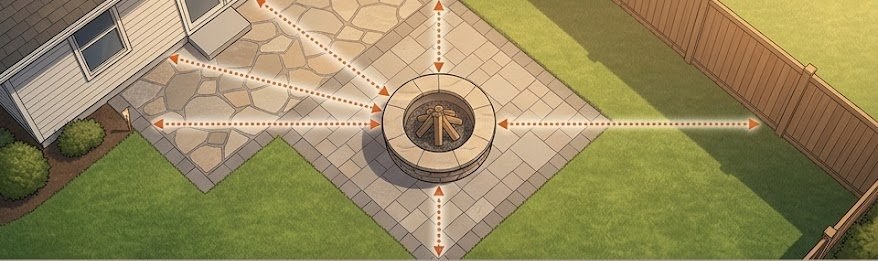
Most U.S. jurisdictions base their setback rules on the International Fire Code (IFC) Section 307, sometimes with local amendments. The IFC establishes three distinct setback tiers:
| Feature Category | IFC Setback from Structures | IFC Setback from Combustible Fences | Code Section |
|---|---|---|---|
| Open recreational fire (campfire, open ring) | 25 feet | 25 feet | IFC §307.4 |
| Portable outdoor fireplace (metal bowl, chiminea) | 15 feet | 15 feet | IFC §307.4.3 (2018+) |
| Permanent outdoor fireplace (masonry or prefab fixed) | Set by building permit / site plan | Set by building permit | Building code + zoning |
| Gas fire feature (permanent) | Set by permit / manufacturer clearance | Per manufacturer instructions | Mechanical + building code |
The 25-foot distance for open recreational fires is the baseline that catches most homeowners off guard. On a standard 6,000 sq ft suburban lot with a 1,400 sq ft house, the geometric reality is that very few open locations exist where a fire pit can be placed 25 feet from all combustibles. This is exactly why the portable outdoor fireplace provision (15 feet, if your jurisdiction has adopted IFC 2018 or later) matters so much.
How Setbacks Are Measured
Setbacks are measured from the edge of the fire feature (the outermost edge of the pit, bowl, or firebox) to the nearest point of the structure or fence being measured from. Not from the center. Not from the flame. From the edge of the feature itself.
For a fire pit with a 3-foot diameter, the edge of the pit is 1.5 feet from its center. If the center of your fire pit is 26 feet from your house, the nearest edge is at 24.5 feet — a setback violation under the 25-foot rule.
For masonry outdoor fireplaces, the setback is measured from the face of the firebox opening or the outer edge of the structure — not from the chimney. The firebox opening is the point of greatest heat and spark emission, so measurement starts there.
What Counts as "Combustible Material"
The IFC setback applies to combustible material, not just buildings. Inspectors and fire marshals apply this broadly. Common combustibles that must be included in your setback measurements:
- Wood fences — cedar, pine, redwood, all standard wood fencing
- Vinyl and composite fences — technically combustible; most inspectors include them
- Dry landscaping material — mulch, bark, dried grass, brush piles
- Lumber piles or firewood storage — must be kept at setback distance from operating fire
- Pergolas and shade structures — especially wood or fabric structures
- Overhead deck or patio covers — any combustible structure directly above counts
- Vehicles — parked cars, trailers, boats
- Propane tanks — many codes require 10-foot minimum from open flame regardless of setback rules
Concrete block walls, brick walls, and metal fences are generally considered non-combustible and do not trigger the standard setback requirement — though local codes may still specify minimum distances from them.
Property Line Setbacks
The IFC does not specify a setback distance from property lines for recreational fires — it only specifies distances from combustible structures and material. However, almost all jurisdictions add a local property line setback requirement, typically 5–15 feet. This is where the two sets of rules — fire code and zoning — must both be satisfied simultaneously.
In practice, you need to identify three measurements and satisfy all three:
- Fire code setback from structures and combustible fences (IFC or local)
- Fire code setback from combustible material (same rule)
- Zoning setback from property lines (local zoning ordinance)
The most restrictive measurement governs. A fire pit that passes the fire code setback but violates the zoning setback is still a violation.
How Local Amendments Change the Numbers
Local jurisdictions routinely amend the IFC setback provisions. Common patterns:
- High fire risk areas (WUI zones): Many western jurisdictions have adopted stricter setbacks — 15 feet for portable units, 25 feet for open fires, with some banning open-wood burning in designated Wildland-Urban Interface zones entirely
- Dense urban areas: Some cities with small lots have adopted lower minimums for enclosed portable units (10 feet) while maintaining or increasing requirements for open fires
- Gas fire features: Many jurisdictions set gas fire feature setbacks at 10 feet from structures — significantly less than wood-burning rules — which makes gas the practical choice in tight yards
Gas Fire Feature Setbacks: Typically Different Rules
Gas fire features — propane tables, natural gas fire bowls, gas outdoor fireplaces — are usually governed by different setback standards than wood-burning features. The key sources:
- Manufacturer's clearance requirements: Every gas fire feature has listed minimum clearances in its installation instructions. These are typically 12–36 inches from combustible surfaces above, behind, and to the sides of the appliance — much tighter than fire code setbacks because gas burns clean without sparks
- Local code minimum: Most jurisdictions set a minimum of 10 feet from structures for gas fire features, though some require 15 feet
- Gas meter clearance: Almost all codes require 3–5 feet minimum clearance between a gas fire feature and the gas meter
The practical result: a gas fire feature can often be placed in a location where a wood-burning feature would be prohibited, simply because the setback rules are less demanding.
When You Can't Meet the Setback
If your desired fire feature location doesn't meet setback requirements, four options exist:
- Move the feature. Even 2–3 feet of relocation can resolve a setback shortfall. Remeasure before giving up.
- Change the feature type. An open fire pit at 20 feet violates the 25-foot rule. An enclosed metal fire bowl at 20 feet may comply under the 15-foot portable fireplace provision (IFC 2018+). Same location, compliant feature.
- Switch to gas. A gas fire feature at 12 feet from the house may comply where a wood-burning pit at the same distance does not.
- Apply for a variance. A formal variance from the setback requirement, available through your Board of Zoning Appeals or equivalent body, allows a documented exception. This requires neighbor notification and a hearing, but is approved routinely for fire features that pose minimal actual risk.
DocSafe 48" Round Fire Pit Mat
4-layer fireproof mat protects decking, patios, and grass from heat, sparks, and embers. Waterproof and reusable — the non-combustible barrier most building departments expect when placing a fire feature on a combustible surface.
As an Amazon Associate, FireFeatureRules earns from qualifying purchases. Price subject to change. Last verified June 2025.