Do You Need a Permit for a Wood-Fired Pizza Oven? A Complete Guide
Whether your backyard pizza oven requires a permit depends on whether it's portable or masonry, how it's classified under fire code, and your city's specific rules. Here's everything you need to know.
The Key Distinction: Portable vs. Built-In
The permit question for pizza ovens comes down to one fundamental difference: portable/prefab ovens versus built-in masonry ovens. These are treated completely differently by building departments.
Oven Type
Examples
Building Permit
Notes
Portable countertop oven
Ooni Koda, Ooni Fyra, Gozney Roccbox
Usually No
Freestanding; no installation required
Larger portable oven
Ooni Pro 16, Gozney Dome, Alfa 5 Minuti
Usually No
Still portable; may use gas or wood
Prefab modular oven on a stand
Forno Bravo Primavera, Fontana Gusto
Check Locally
Depends on whether it's on a permanent base
Masonry dome oven (kit)
Forno Bravo Premio, Chicago Brick Oven
Yes
Masonry construction; permit required
Custom masonry oven
Built from firebrick and refractory mortar
Yes
Full building permit; typically fire inspection
Oven integrated into outdoor kitchen
Any oven built into a countertop structure
Yes
Outdoor kitchen permit covers oven
The IFC Classification Problem
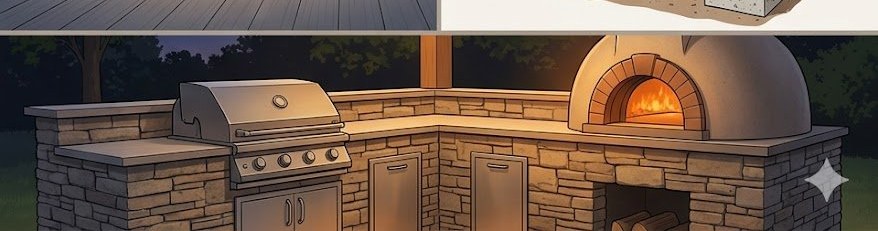
A built-in pizza oven integrated into an outdoor kitchen counter requires a building permit and is reviewed as a permanent masonry structure. and How to Solve It
Built-in masonry pizza ovens frequently encounter a specific permit problem: the building department classifies the wood-burning oven as a "recreational fire" under the International Fire Code, then rejects the permit because a recreational fire requires a 25-foot setback from combustible material — which is impossible on most residential lots.
This classification is incorrect under the IFC. A wood-fired pizza oven is not a recreational fire because the fuel is enclosed within a firebox structure — it's more accurately classified as an outdoor cooking appliance or outdoor fireplace, both of which are explicitly excluded from the IFC recreational fire definition (Section 307.1.1).
When this rejection happens, the response that works: submit a written appeal citing IFC 307.1.1 and explaining that the enclosed firebox construction removes the oven from the recreational fire category. The appeal should request reclassification as an outdoor cooking appliance or masonry cooking structure. This argument has a strong success record when submitted formally in writing.
If you're planning a wood-burning pizza oven in California, Arizona, Colorado, Washington, or Oregon, the air quality curtailment program is a significant operational consideration. On curtailment days — which can number 20–40+ per winter season in some areas — burning wood is prohibited, including in pizza ovens.
Gas-fueled pizza ovens (propane or natural gas) are not subject to curtailment rules and can be used year-round. Many serious outdoor cooks in high-curtailment areas install a dual-fuel oven that accepts both wood and gas, giving them the option of either depending on the day.
SCAQMD Rule 445 and Pizza Ovens in Southern California
SCAQMD Rule 445 prohibits the installation of new wood-burning fireplaces in new construction and certain renovation scenarios in the South Coast Air Basin. This rule has caused confusion about pizza ovens — specifically, whether a wood-fired oven counts as a "fireplace" under Rule 445.
SCAQMD's position is that Rule 445 applies to wood-burning heaters and fireplaces, but cooking appliances (including pizza ovens) are generally addressed differently. However, the line is not always clearly administered at the local building department level. If you're in the SCAQMD area and planning a wood-fired pizza oven, contact SCAQMD directly for a written position before beginning your permit application. This one call can save significant back-and-forth.
Most portable pizza oven manufacturers explicitly prohibit use on combustible surfaces including wood decking. The underside of a pizza oven reaches very high temperatures, and placing it directly on wood decking creates a fire risk. Always use a non-combustible surface — a concrete paver, stone slab, or purpose-built oven stand. Composite decking (Trex, TimberTech) is also not rated for pizza oven use in most cases.
For most building departments, yes — a wheeled unit that is not attached to a foundation or plumbed to a gas line is treated as portable equipment, not a structure requiring a permit. However, if it's functionally never moved and sits in a fixed location on a permanent pad, some jurisdictions may treat it as permanent. The test is whether it could be picked up and moved without demolition or gas disconnection.
Requirements vary by jurisdiction and oven design. As a general rule, the IFC and most local codes require that chimneys and flues extend at least 2 feet above any combustible material within 10 feet horizontally, and at least 3 feet above the highest point of roof penetration if the chimney passes through a roof. For a freestanding masonry pizza oven in an open yard, the 2-foot-above-10-foot rule typically governs. Your plan reviewer will specify the exact requirement.
Yes — if the pizza oven is integrated into an outdoor kitchen structure (built into a countertop, enclosed in masonry, or plumbed to gas), the outdoor kitchen structure itself requires a building permit and the oven is reviewed as part of that project.
Disclaimer: This page is for general informational purposes only. Rules vary by jurisdiction. Always verify with your local building department and relevant authorities before constructing or operating any outdoor fire feature. This is not legal advice.