Why Outdoor Kitchens Are a Different Category
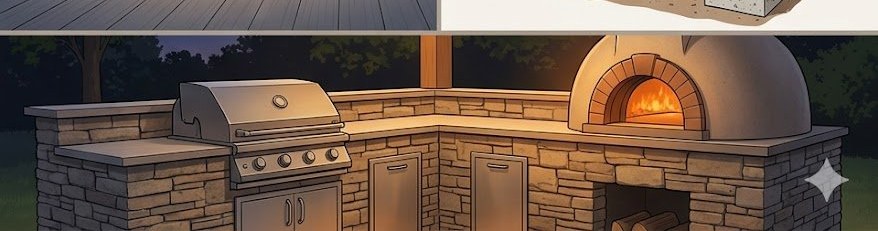
An outdoor kitchen with an integrated fire feature is not just a fire pit with counters around it — it's a constructed accessory structure that triggers a full building permit review. The moment you attach a fire feature to a countertop or enclose it within masonry, stone, or concrete block, you've crossed from "recreational fire" territory into "permanent structure" territory, and the entire permit framework changes.
The practical implication: you can't just pull a fire pit permit. You'll typically need a building permit for the structure, a plumbing/mechanical permit for the gas line, and potentially an electrical permit for lighting, outlets, or ignition systems. Each of these is a separate application in most jurisdictions, and each has its own inspection sequence.
What Permits an Outdoor Kitchen Typically Requires
| Work Item | Permit Type | Who Issues It | Who Does the Work |
|---|---|---|---|
| Masonry or concrete block countertop/structure | Building permit | City/county building dept. | Owner-builder or licensed contractor |
| Natural gas line from meter to kitchen | Plumbing or mechanical permit | City/county building dept. | Licensed plumber/gas fitter (most states) |
| Propane system (tank + regulator + piping) | Plumbing/mechanical permit | City/county building dept. | Licensed contractor |
| Electrical outlets, lighting, exhaust fan | Electrical permit | City/county building dept. | Licensed electrician (most states) |
| Concrete pad or footing | Part of building permit | Included with building permit | Owner-builder or contractor |
| Pergola or shade structure over kitchen | Separate building permit | City/county building dept. | Owner-builder or contractor |
| Plumbing (sink, water line) | Plumbing permit | City/county building dept. | Licensed plumber |
What Your Site Plan Must Show for an Outdoor Kitchen
An outdoor kitchen permit application requires more detailed documentation than a standalone fire pit. Beyond the standard site plan elements, expect to include:
- Overall dimensions of the kitchen structure (length, depth, height of countertop, height of any overhead elements)
- Elevation drawings showing the side view — especially chimney or vent height
- Location and type of all appliances (grill, burners, pizza oven, smoker, refrigerator, sink)
- Gas line routing from meter to kitchen, including pipe size and material
- Electrical layout showing outlets, lighting, and panel circuit information
- Structural details for the countertop support if spanning more than 4 feet
- Setback dimensions from all structures, fences, and property lines
- Clearance above the cooking surface to any overhead structure
Overhead Clearance Requirements for Outdoor Kitchens
One of the most commonly violated requirements in outdoor kitchen projects is overhead clearance above cooking appliances. Requirements vary by appliance type and fuel:
- Gas grills and burners: Most manufacturers specify 36-inch minimum from combustible overhead surfaces. Many local codes require 36–48 inches. Non-combustible overhead (steel roof, masonry) may have different requirements.
- Wood-burning pizza ovens in outdoor kitchens: Chimney height and clearance requirements apply. Most codes require the chimney to extend 3 feet above the highest point of any overhead structure within 10 feet.
- Gas pizza ovens: Manufacturer clearances typically specify 24–36 inches minimum to combustible overhead surfaces.
- Pergola covers: Open pergola slats are often treated as non-combustible for clearance purposes; solid wood pergola roofs are treated as combustible surfaces.
HOA Review for Outdoor Kitchens
An outdoor kitchen is almost always subject to HOA Architectural Control Committee (ACC) review, even in communities where portable fire pits would pass without approval. The combination of permanent masonry, visible height, and potential smoke generation puts outdoor kitchens squarely in the category of projects that HOAs evaluate carefully.
Start the HOA process before designing or permitting the kitchen. HOA aesthetic requirements (stone type, countertop material, maximum height, roof or no roof) can significantly affect your design. Getting HOA approval first means you design once to both sets of requirements rather than designing twice.
Inspection Sequence for Outdoor Kitchens
Outdoor kitchen projects typically require inspections at each of these stages:
- Footing inspection — before pouring any concrete; inspector verifies footing depth, dimensions, rebar
- Gas rough-in inspection — before burying or concealing any gas piping; pressure test required
- Electrical rough-in inspection — before burying or concealing electrical conduit or wiring
- Framing/masonry inspection — after structural work is up but before finishing; inspector verifies dimensions and clearances
- Chimney inspection — if applicable; inspector verifies height and cap
- Final inspection — all work complete; all appliances installed; clearances maintained; gas pressure test signed off