Step 1: Determine Whether You Need a Permit
The first step is not filling out forms — it's determining whether a permit is required at all. As a general rule for outdoor fire features in the U.S.:
- No permit needed: Portable fire pits, fire bowls, chimineas, portable pizza ovens, and propane fire tables that are not permanently connected to a gas line and don't have a foundation
- Permit almost always needed: Masonry construction of any kind, permanent gas line connections, structures on concrete footings, outdoor kitchens with integrated fire features, anything attached to the home
- Gray area — call first: Prefab steel fire pits on a permanent paver or concrete pad, high-BTU propane units with a conversion to natural gas, large precast concrete fire bowls on a slab
The fastest way to confirm: call your local building department's permit counter and describe what you're planning. Most departments can tell you in a two-minute phone call whether a permit is required. This call is free, and it's far less costly than building without a permit and having to tear it out.
What You'll Need to Apply
For a typical residential outdoor fire feature permit (masonry fire pit, outdoor fireplace, or pizza oven), most building departments will ask for:
- A completed permit application form — available at the building department counter or online portal
- A site plan — a drawing of your property (not architect-level, but to scale) showing the location of the proposed feature relative to: property lines, your home, fences, and other structures. Setback distances must be labeled.
- Construction drawings or product specifications — for masonry features: a drawing showing dimensions, materials, and chimney height. For prefab units: manufacturer specifications showing BTU rating, dimensions, and clearance requirements.
- Project description and valuation — a description of the scope of work and your estimated project cost (used to calculate the permit fee)
- HOA approval letter — some building departments require documented HOA approval if the property is in a governed community
For gas line work, you'll also need:
- A plumbing or mechanical permit application (usually separate from the building permit)
- Licensed contractor information (most states require a licensed plumber for gas work)
- A description of the gas line route and connection point
Free Site Plan Checklist PDF
A printable checklist covering everything your building department will typically ask for on a fire feature permit application.
How to Draw a Site Plan
A site plan doesn't need to be professional or printed on large paper. Most building departments accept a hand-drawn site plan as long as it's legible, drawn to scale, and includes required information. Here's what to include:
- Property boundaries with dimensions
- Location of your home on the lot (with dimensions from house to property lines)
- Proposed location of the fire feature with dimensions from: the nearest structure, all property lines, and combustible fences
- All setback distances labeled in feet
- North arrow
- Scale notation (e.g., 1 inch = 10 feet)
- For gas work: proposed gas line route from existing meter to feature
Satellite imagery from Google Maps can be printed and used as a base for your site plan. Many homeowners trace their lot boundaries from a county assessor's property map (available free online in most counties) and add hand-drawn feature locations on top.
The Review and Approval Process
Once you submit your application, the typical process runs:
- Over-the-counter review (same day): Simple, straightforward projects — a basic masonry fire pit with no gas, clear setback compliance — may be approved over the counter at the permit window. The reviewer looks at your plans, asks a few questions, and issues the permit on the spot. Permit fee is collected at this time.
- Standard plan check (1–3 weeks): More complex projects or jurisdictions with high permit volumes may require plans to be submitted and reviewed by a plan checker. You'll receive comments and may need to revise and resubmit.
- Corrections and resubmittal: If the reviewer has corrections (missing setback dimensions, insufficient chimney height for a masonry fireplace, etc.), you'll receive a correction letter. Address the corrections, revise your plans, and resubmit. Most corrections can be resolved in one round.
- Permit issuance: Once approved, your permit is issued and you pay the fee (if not paid at submission). The permit card must be posted at the job site.
Typical Permit Costs
Building permit fees vary widely by jurisdiction. They are typically calculated as a percentage of the project's declared valuation or as a flat fee for minor work. For a residential outdoor fire feature:
| Project Type | Typical Permit Fee Range | Notes |
|---|---|---|
| Simple masonry fire pit | $100–$300 | Most jurisdictions; over-the-counter |
| Masonry outdoor fireplace | $200–$600 | Varies by project valuation |
| Built-in pizza oven | $150–$400 | Often permitted as masonry appliance |
| Outdoor kitchen with fire feature | $400–$1,200 | Larger project valuation |
| Gas line permit (residential) | $75–$250 | Plumbing/mechanical permit; separate from building permit |
| Gas inspection fee | $50–$150 | Some jurisdictions charge separately |
These are ballpark figures. High-cost areas (San Francisco, New York, coastal California) typically have higher permit fees. Rural areas and smaller municipalities often have lower fees. Your permit fee does not include contractor costs — it is the fee paid to the building department for the review and inspection service.
What Inspectors Check
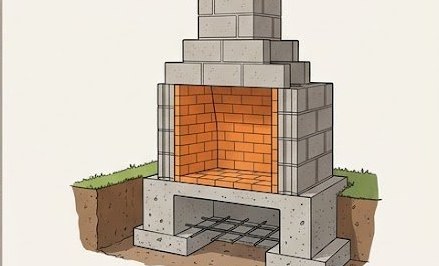
After your permit is issued and construction begins, you'll need to request inspections at specific stages. For a masonry outdoor fireplace or fire pit, typical inspections include:
- Footing inspection: Before pouring concrete for the foundation — inspector verifies footing depth, dimensions, and rebar
- Rough masonry or framing inspection: After the firebox walls are up but before any finishing — inspector verifies dimensions, materials, and setbacks
- Chimney / flue inspection: Verifies chimney height, clearances, and cap installation
- Final inspection: Verifies completion of all work per approved plans; post the permit card until this inspection passes
For gas line work, a pressure test inspection is required before the line is buried or concealed. This is non-negotiable — a gas line that hasn't passed a pressure test is a liability and insurance issue.
To request an inspection, call your building department's inspection request line or use the online portal (most medium-to-large cities have these now). Give at least 24 hours notice; many departments offer next-business-day inspections for residential work.
What to Do If Your Permit Is Denied
A permit denial is not the end of the road. Typical paths forward:
- Correct and resubmit: Most "denials" are actually correction requests — adjust your plans to address the specific issues cited and resubmit
- Appeal the classification: If your permit was denied because the feature was misclassified (e.g., a pizza oven classified as a recreational fire — see our IFC guide), submit a written appeal with code citations
- Request a variance: If the denial is due to a setback issue, you may apply for a variance. A variance allows a deviation from standard setback rules and typically requires notification to adjacent property owners and a hearing
- Redesign: Sometimes the simplest solution is to move the feature further from the property line, switch from wood-burning to gas, or reduce the scale of the project to below the permit threshold
- Hire a permit expediter: In complex situations or high-volume building departments, a permit expediter (a professional familiar with the local department's process and reviewers) can navigate corrections faster than a homeowner acting alone
Building Without a Permit: The Risks
Skipping a required permit might seem like a time-saver, but the consequences are disproportionate. Common issues for unpermitted fire features:
- Home sale complications: Home inspectors check permit history. Unpermitted work disclosed at closing can kill a sale, require price reductions, or require you to retroactively permit and pass inspection before closing.
- Insurance problems: Many homeowner's policies exclude damage caused by or to unpermitted structures. A fire that damages your home while your unpermitted outdoor fireplace was in use creates a legitimate basis for claim denial.
- Code enforcement: Neighbor complaints trigger code enforcement visits. An inspector who spots an unpermitted masonry structure can require demolition.
- Retroactive permitting: Most jurisdictions allow you to apply for an after-the-fact permit, but the process typically requires exposing work for inspection and may require modification or demolition of non-compliant elements.
For a masonry outdoor fireplace or outdoor kitchen, the permit cost is almost always under $500. The cost of retroactive permitting, let alone the insurance and sale complications of unpermitted work, is orders of magnitude higher. Pull the permit.
Frequently Asked Questions
Fire Pit Spark Screen, 24 Inch Round — Heavy Duty Mesh Cover with Handle & Poker
Most building departments and the IFC require a spark arrestor on any wood-burning fire feature. A heavy-duty mesh spark screen is typically what inspectors look for during the final inspection of masonry fire pits and fireplaces. Collapsible design with handle and poker included.
As an Amazon Associate, FireFeatureRules earns from qualifying purchases. Price subject to change. Last verified June 2025.