Fire Pit Rules for Wood Decks and Composite Decking
Using a fire pit on a deck is one of the most common homeowner questions — and one of the most misunderstood. Here is exactly what the codes say, what manufacturers allow, and what actually matters for safety.
Updated May 20258 min read
⚠️
Most wood-burning fire pits should not be used directly on wood or composite decking without a non-combustible barrier. Manufacturer instructions and local fire codes typically prohibit it. Read the specific rules for your unit before placing any fire feature on a deck.
The Baseline Rule
Under the IFC and most local fire codes, open recreational fires (including open wood-burning fire pits) must be placed on non-combustible ground. Wood decking and composite decking are combustible surfaces. This means an open wood-burning fire pit on a wood deck is generally a code violation — independently of any manufacturer restrictions.
The nuance comes with enclosed portable fire features (chimineas, fire bowls with enclosed bases, gas fire features) where the listing documents and manufacturer instructions may specifically address deck use.
Wood-Burning Fire Pits on Decks — The Rules
For wood-burning fire pits of any type (open ring, bowl with mesh screen, chiminea):
Open fire pits on wood decks: Prohibited under most fire codes. The decking surface is combustible. Sparks and embers land on the deck surface. Even with a spark screen, embers pass through and land on the deck. The risk of deck ignition is real — this is not a theoretical concern.
Chimineas on decks: The enclosed firebox reduces spark exposure, but the base of a chiminea (especially cast iron) reaches very high temperatures and can char composite decking. Most chiminea manufacturers explicitly prohibit use on combustible surfaces without a non-combustible pad.
Elevated decks: If the deck is more than 30 inches off the ground, there is typically no compliant way to use a wood-burning fire feature on it. The combination of proximity to the combustible deck surface, the elevated fire creating additional draft, and the difficulty of emergency extinguishing makes this a high-risk configuration.
Gas Fire Features on Decks
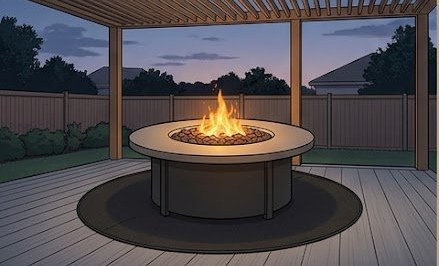
A gas fire table on a fireproof ember mat — the non-combustible barrier satisfies most building department concerns about placing a fire feature on composite decking. — Different Rules
Gas fire features (propane tables, natural gas fire bowls) are treated differently because:
No sparks or flying embers
Combustion is contained within the burner housing
Flames are controllable and immediately extinguishable
Bottom surfaces are typically engineered with air gaps that reduce heat transfer to the surface below
Many gas fire tables are specifically listed (CSA, UL, or AGA certified) for use on combustible surfaces including wood and composite decking. However, this is product-specific — you must check the listing documents for your specific unit, not assume all gas fire tables are deck-safe.
Key things to verify for deck use with a gas fire table:
Does the product listing specifically state "suitable for use on combustible surfaces"?
What is the required clearance above the unit to overhead combustibles (deck covers, pergola roofs)?
Does the unit meet ANSI Z21.97 (the standard for outdoor decorative gas appliances)?
Does your homeowner's insurance exclude damage caused by fire features on decks?
Non-Combustible Barrier Mats
For fire features that are not listed for combustible surface use but that you want to place on a deck, a non-combustible barrier pad is the standard solution. Products like the DocSafe 48" Round Fire Pit Mat — a 4-layer fireproof pad rated for use under fire pits, grills, and portable fire bowls on decks, patios, and grass — are sold specifically for this purpose at outdoor retailers and on Amazon. What to look for:
Rated for outdoor fire feature use (not just grilling mats — the temperature requirements are different)
Large enough to extend 12–18 inches beyond the base of the fire feature on all sides
Non-combustible material — ceramic fiber, fiberglass, or equivalent
High-temperature rating: fire pit pads must be rated for continuous temperatures of at least 500°F and intermittent temperatures significantly higher
A mat resolves the deck surface combustibility issue but does not resolve overhead clearance requirements or the general fire code prohibition on open fires near combustible structures. Using a mat under a wood-burning fire pit on a deck may satisfy manufacturer requirements but likely does not fully satisfy fire code setback requirements from the deck's overhead structure or combustible railings.
The Overhead Clearance Problem
Even if you resolve the deck surface issue, decks with overhead structures (pergola covers, second-floor balconies, patio covers) present an additional challenge. Most fire codes and manufacturer instructions require significant overhead clearance:
Wood-burning features: typically 10–21 feet of clearance to overhead combustible material
Gas fire features: typically 36–48 inches to overhead combustible material (product-specific — check your unit)
A deck under a second-floor balcony with 8 feet of overhead clearance is not a compliant location for most fire features regardless of the deck surface treatment.
Feature Type
On Wood Deck?
On Composite Deck?
Condition
Open wood-burning fire pit
No
No
Combustible surface — prohibited
Chiminea (clay or cast iron)
No
No
High base temps — check manufacturer; use pad if specified
Gas fire table (listed for combustible surfaces)
Yes
Yes
Only if product listing specifically states this
Gas fire table (not listed for combustible)
With pad
With pad
Non-combustible barrier mat required; verify with mfr
Any fire feature under 8-ft overhead structure
No
No
Overhead clearance failure regardless of surface
Recommended Product
DocSafe 48" Round Fire Pit Mat
4-layer fireproof mat protects decking, patios, and grass from heat, sparks, and embers. Waterproof, reusable, and rated for use under fire pits, grills, and portable fire bowls. The non-combustible barrier most building departments expect when placing a fire feature on a combustible surface.
As an Amazon Associate, FireFeatureRules earns from qualifying purchases. Price and availability subject to change. Last verified June 2025.
Social media is full of fire features on composite decks, and many of them are not code-compliant or manufacturer-approved. Trex and similar composite decking manufacturers explicitly warn against placing fire features directly on their products without a non-combustible pad, and even then, open wood-burning features are generally not recommended. The fact that it happens doesn't mean it's safe or legal. Insurance companies do look at these factors when a fire claim is filed.
Depends on the pergola type and the specific fire table's listed clearances. An open pergola with widely spaced wooden slats and 10+ feet of clearance to any horizontal surface is different from a solid pergola roof or a covered patio. Check your specific fire table's installation instructions for the minimum clearance to overhead combustible material — this is a product-by-product specification that ranges from 36 inches to 8 feet depending on BTU output and design.
A low-BTU, CSA-listed gas fire table that is specifically listed for use on combustible surfaces, with at least 36 inches to any overhead combustible surface, and a shutoff valve you can reach easily. Place it on a level, stable surface, keep it away from deck railings (typically 3+ feet), and never leave it unattended with guests who might bump or tip it. This is the configuration with the most favorable combination of safety, regulatory compliance, and usability on a deck.
Disclaimer: For general informational purposes only. Always verify with your local building department. Not legal advice.